
Skip to content
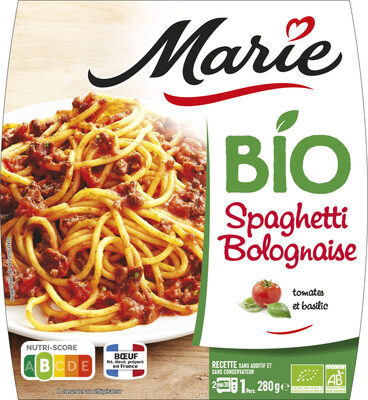
Spaghetti bolognaise BIO
Spaghetti bolognaise BIO - Marie with score 95/100

Spaghetti bolognaise BIO - European Score 95/100

Marie

Spaghetti bolognaise BIO by Marie is rated 95/100 according to our European origin criteria. Excellent choice! This product strongly supports the European economy.

It is a food product found in 1 countries. Manufacturing reported in: Sablé.

280 g

3248830000112
🛡️ Data verified by Open Food Facts
🍽️ Food

Nutritional Scores

Nutri-Score
C
Eco-Score
C
NOVA
3

Ingredients

_spaghetti_ cuit 37,8% (eau, semoule de _blé_ dur*), pulpe de tomates au jus 20,2% (tomate*, jus de tomate*), viande bovine* cuite origine France VBF 9,4%, eau, double concentré de tomates* 5,3%, échalotes* 4,3%, _emmental_*, huile d'olive* vierge extra 3,5%, _fromage_* râpé, _crème_* fraîche, fécule de manioc*, ail* 0,7%, sel, basilic* 0,4%, poivre blanc*, curcuma*, persil*

Allergens

gluten, milk, fr:spaghetti

Origin Data

Countries france
Manufacturing Places Sablé
EMB Code EMB 72264J, FR 72.264.003 CE
Packaging Carton, Barquette, Barquette plastique, Etui en carton, Film en plastique

European Score

0 /100
Purebred European

"More European than the Eurovision Song Contest."

Detailed Breakdown:

Scoring Methodology
Headquarters 35/35
Manufacturing 35/35
Ingredients 0/10
Distribution 15/15
EU Certifications +5
Proximity +5

Analysis:

  • Corporate headquarters in France & Monaco (+35 pts)
  • European packaging code (EMB 72264J) (+35 pts)
  • Main ingredients not European
  • Distributed exclusively in Europe (1 countries) (+15 pts)
  • European certification: eu-organic (+5 pts)
  • Bonus: Completely European product (+5 pts)
Amazon logo
Buy on Amazon

Affiliate link. Independent from score results.

Analysis & Insights

Expert Data Analysis

With a critical score of 0/100, Spaghetti bolognaise BIO shows a total lack of verifiable alignment with European industrial sovereignty.

When analyzing the corporate structure of Marie, we see its direct and positive impact on the regional economy.

From an environmental perspective, this product aligns with modern sustainability goals through local sourcing.

The lack of transparent health data for this product is a significant concern for the European consumer.

Traceability is at the heart of this product, with clear indicators of its verified European origin.

Fact-based analysis identifies the product as a poor choice for those prioritizing local roots.

Looking for better alternatives...