Häagen-Dazs: The Founding Father of Fake Branding

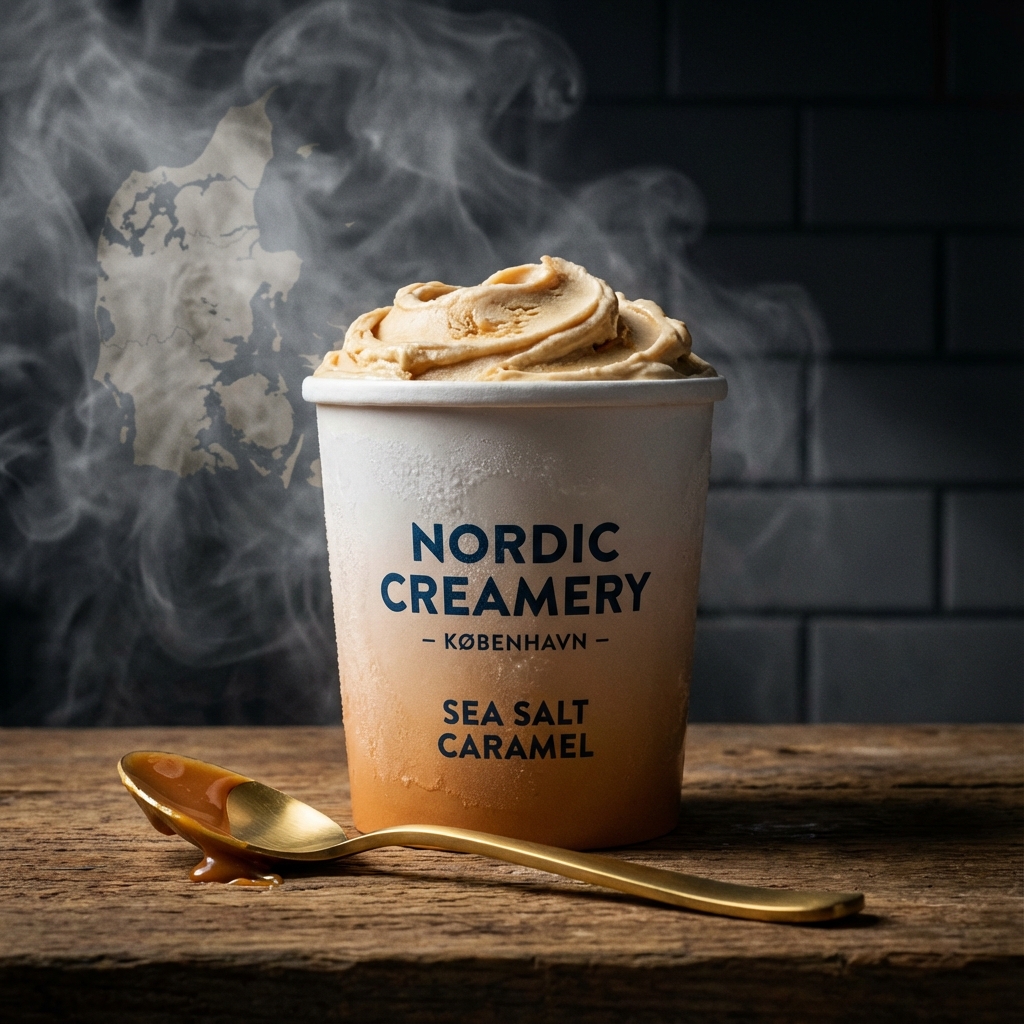
If there's a Mount Rushmore of foreign branding, Häagen-Dazs would be carved right in the centre. This is the brand that didn't just use the foreign branding playbook—it wrote the playbook. Every premium ice cream, every faux-European cosmetics line, every fake Japanese streetwear brand owes a debt to a Jewish immigrant sitting at his kitchen table in the Bronx, muttering nonsense syllables until he struck marketing gold.
The Promise
Close your eyes and say the name: Häagen-Dazs. What images come to mind? Perhaps a quaint creamery in Copenhagen, where a family of blonde Scandinavians has been crafting ice cream using recipes passed down through generations. Snow-capped rooftops, pristine dairy farms, cows grazing on impossibly green grass under the pale Nordic sun. The very name conjures centuries of Danish craftsmanship, European artisanal quality, and the kind of meticulous attention to detail that only Old World traditions can provide.
The packaging reinforces this narrative: elegant, understated, sophisticated. This isn't ice cream for children at a birthday party—this is a sensory experience for discerning adults who appreciate the finer things in life. The Scandinavian name suggests purity, naturalness, and a commitment to quality that transcends mere commerce.
It sounds like a family creamery in Copenhagen that has been operating since the 1800s, shipping its precious frozen cargo across the Atlantic for Americans lucky enough to afford it.
The Reality
Here's the truth that marketing executives would rather you didn't know:
Häagen-Dazs was invented in 1960 in the Bronx, New York, by Reuben Mattus, a Polish-American Jewish entrepreneur who had been selling Italian lemon ices from a horse-drawn cart since the 1920s. There is no Danish heritage. There is no ancestral recipe. There is no picturesque creamery in Scandinavia.
The name "Häagen-Dazs" is complete and utter gibberish. It means absolutely nothing in Danish, Swedish, Norwegian, or any other language on Earth. It is a made-up word, invented by a man who didn't speak a word of any Scandinavian language, designed specifically to sound foreign and sophisticated to American ears.
The umlaut over the 'a'? It doesn't exist in Danish. The Danish language has the letters æ, ø, and å, but no ä. Mattus added it purely for visual effect—a made-up diacritical mark on a made-up word, creating a doubly fictional Scandinavian identity.
Reuben Mattus spent his early career competing against mass-market ice cream brands that were cutting costs by adding air, artificial flavours, and stabilisers to their products. He was a craftsman in a market being flooded with cheap imitations, and he needed a way to stand out.
The Brilliant Trick
The Name Game
According to Mattus family lore, Reuben sat at his kitchen table for hours, literally babbling sounds until he found a combination that sounded sufficiently "Danish" to American ears. He wasn't looking for meaning—he was looking for feeling. The goal was to create a name that would instantly communicate "premium European quality" without actually saying anything at all.
He chose Denmark specifically for three reasons:
-
Dairy Reputation: Denmark was known for high-quality dairy products. The association between Scandinavian countries and pure, natural foods was already established in American consciousness.
-
Historical Gratitude: As a Jewish immigrant who lost relatives in the Holocaust, Mattus felt a deep personal connection to Denmark—one of the few European countries that actively protected its Jewish population during the Second World War. The Danes famously helped evacuate nearly all their Jewish citizens to neutral Sweden.
-
Exotic but Accessible: Scandinavian names sounded foreign enough to be intriguing, but not so foreign as to be off-putting. Italian might seem overdone, French too pretentious, German too harsh. Danish hit a sweet spot of exotic sophistication.
The Visual Deception
Mattus didn't stop at the name. The original Häagen-Dazs packaging featured a map of Denmark, complete with Copenhagen marked prominently. This wasn't an accident or a designer's whim—it was a deliberate visual cue designed to cement the Scandinavian illusion in consumers' minds.
The map was eventually removed (though the brand never publicly explained why), but by then the association had been established. Generations of consumers had absorbed the Danish narrative, and it had become an unquestioned part of the brand's identity.
Premium Positioning
Mattus made another crucial decision: he would sell his ice cream at a 40-50% premium over competitors. This wasn't just about margin—it was about psychology. The high price reinforced the perception of quality. Consumers reasoned that if Häagen-Dazs cost more, it must be better. The fake Danish identity justified the price, and the price validated the fake Danish identity. A perfect feedback loop.
He also insisted on using only high-quality, natural ingredients—no artificial colours, flavours, or stabilisers. This meant the product actually was premium quality, which helped sustain the illusion. Häagen-Dazs customers weren't just buying a story; they were buying genuinely good ice cream. The foreign branding was the hook, but the product delivered on the promise.
The Legal Battle That Legitimised Fake Branding
The success of Häagen-Dazs inevitably attracted imitators. In 1980, a company called Frusen Glädjé (Swedish for "frozen delight"—at least this name actually meant something) launched a competing premium ice cream with its own Scandinavian aesthetic.
Remarkably, Häagen-Dazs sued, arguing that Frusen Glädjé was unfairly trading on the Scandinavian image that Häagen-Dazs had established. Think about the audacity: a company with a fake Danish name, invented by a man from the Bronx, was suing a competitor for also pretending to be Scandinavian.
Even more remarkably, Häagen-Dazs lost. The court ruled that you cannot trademark or protect the general concept of "Scandinavian-ness." Since neither company was actually Scandinavian, neither had exclusive rights to Nordic imagery. The judge essentially declared that pretending to be from another country is fair game for everyone.
This decision had far-reaching implications. It established that foreign branding exists in a legal grey zone where it's perfectly acceptable to create any national impression you like, as long as you don't make explicitly false "Made in..." claims. The floodgates were opened, and countless brands would follow Häagen-Dazs through them.
The Result
From a single shop in Brooklyn, Häagen-Dazs grew into a global empire. The brand was acquired by Pillsbury in 1983, then by General Mills, and today is co-owned by Nestlé in most international markets. It generates billions of dollars in annual revenue and is sold in over 50 countries.
The Danish illusion has proven remarkably durable. Surveys consistently show that many consumers believe Häagen-Dazs is a European brand. Even when told the truth about its American origins, many continue to buy it—the brand has become so established that its fictional heritage feels more "real" than the actual facts.
Today, Häagen-Dazs operates cafés around the world, sells at premium prices in supermarkets everywhere, and remains the benchmark against which all premium ice creams are measured. All thanks to a made-up name that sounds vaguely Danish but means absolutely nothing.
The Legacy
Häagen-Dazs didn't just create a successful ice cream brand—it created a template that would be followed by hundreds of companies across dozens of industries:
- Identify a country associated with quality in your product category
- Create a name that sounds like it could be from that country
- Add visual cues (maps, flags, imagery) to reinforce the association
- Price at a premium to signal quality
- Never explicitly claim the false origin—let consumers assume
This playbook, pioneered by a Bronx ice cream maker in 1960, remains the foundational strategy of foreign branding to this day.
What We Can Learn
The Häagen-Dazs story teaches us uncomfortable truths about ourselves as consumers:
-
We want to believe: Even when the deception is revealed, many consumers prefer to maintain the illusion. The story is more appealing than the reality.
-
Sound matters more than meaning: Mattus proved that the phonetic qualities of a name matter more than its actual meaning. A name that sounds premium will be perceived as premium, regardless of whether it means anything at all.
-
Price signals quality: The willingness to charge more was itself a marketing strategy. We're conditioned to believe that expensive things are better, even when the price is arbitrary.
-
First-mover advantage: Häagen-Dazs established the "premium Scandinavian ice cream" category so thoroughly that competitors could only imitate. When you define a category, you own it forever.
Next in the series: Superdry, the British brand that plastered nonsensical Japanese characters across everything—and built a fashion empire on the resulting aesthetic confusion.
Curious how real premium ice creams score on European origin? Check these examples from our database: